Sleeping Bear Dunes Height: How 450 Feet of Sand Rules Lake Michigan
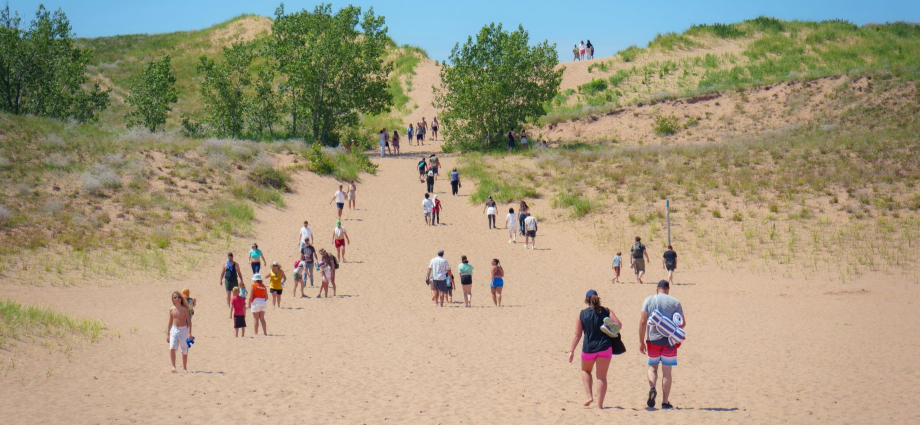
The Sleeping Bear Dunes height is one of those facts that sounds made up until you are standing at the base looking up and wondering what life decisions brought you to this moment. These dunes rise up to 450 feet above Lake Michigan — that is taller than a 40-story building — making them among the highest freshwater coastal dunes on the planet. I have stood at the top with wind whipping sand into my face and watched grown adults sit down mid-descent and refuse to move.
I have also watched kids sprint up like mountain goats while their parents quietly reconsidered their fitness levels. Whether you are here for the views, the geology, or simply to prove something to yourself, understanding the scale of what you are looking at changes everything about the experience. Located inside Sleeping Bear Dunes National Lakeshore on the northwestern coast of Michigan’s Lower Peninsula, these ancient glacial giants are unlike anything else in the Midwest.
How Tall Are Sleeping Bear Dunes, Really?
If you have ever Googled “how tall are Sleeping Bear Dunes” and gotten a vague answer, here is the real breakdown. The dunes themselves sit atop a glacial moraine — essentially a massive ridge of debris left behind when the last great ice sheet retreated roughly 10,000 to 12,000 years ago. The moraine alone lifts the landscape about 200 feet above the lake. Sand blown in from exposed lake beds has piled on top of that over millennia, pushing the total Sleeping Bear Dunes height to as much as 450 feet in certain spots.
The Dune Climb Trailhead Elevation
The most visited section, the Dune Climb on M-109 near Empire, Michigan, starts at around 600 feet above sea level and peaks near 1,000 feet. The trail to the water is about 3.5 miles one way from the Dune Climb parking area, and the elevation changes dramatically in that stretch. You go up, come down, go up again — it is not a straight shot, which is something the trail signs do not tell you loudly enough.
Why the Glacial Foundation Matters
Most coastal dunes are purely sand piled by wind. Sleeping Bear is different because the moraine underneath gives it a structural backbone that keeps these dunes anchored in place. Without that glacial foundation, the dunes would migrate inland over time the way true barrier dunes do. The moraine is what makes the Sleeping Bear Dunes height so dramatically vertical rather than gently sloped — you feel it immediately when you start climbing.
The Sand Death March: Why It’s Brutal and Why You’ll Do It Anyway
The park service is refreshingly honest about the Dune Climb. Signs at the trailhead warn hikers about the difficulty, the heat, the lack of shade, and the very real danger of dehydration. Rangers have a nickname for the full hike to the water’s edge and back: the Dune Climb Death March. I am not here to scare you off. I am here to make sure you know what you signed up for.
What Makes It So Hard
Sand is the enemy of forward momentum. Every step you take sinks, especially on the ascent, so your legs do twice the work of a normal hike. The surface temperature of exposed dune sand on a sunny July afternoon can exceed 130 degrees Fahrenheit. There is zero shade from the parking lot to the lake. The round trip to the water covers about 7 miles with significant elevation change in each direction, and the final push back up to the ridge — after you have already swum in the lake and eaten your lunch and convinced yourself the return hike won’t be that bad — is the moment people genuinely struggle.
Why People Keep Showing Up
Because the view from the top is one of the most jaw-dropping things you will see in the entire Midwest. Lake Michigan stretches out in every direction, the water shifting from pale jade near the shoreline to a deep cobalt farther out. The North and South Manitou Islands float on the horizon like something from a dream. The wind at the ridge smells clean and mineral-sharp, the way big cold water always smells. You can hear almost nothing except wind and the distant sound of waves you cannot yet see. For Michigan with kids, this is the kind of experience that gets talked about for years. Adults too, honestly.
Pro Tip: Start your Dune Climb as early as possible — ideally before 9 a.m. in summer. The sand is cooler, the crowds are thinner, and the light on the lake is spectacular. Bring at least twice as much water as you think you need. I brought a liter once and regretted it deeply.
Sleeping Bear Dunes Facts You Probably Didn’t Know
Beyond the height, there is a lot packed into this stretch of northwestern Michigan shoreline that most day visitors never learn. These Sleeping Bear Dunes facts add layers to what can otherwise feel like a straightforward “walk up a big sand hill” experience.
Named After a Chippewa Legend
The Ojibwe name for this area translates roughly to “Sleeping Bear.” The traditional story tells of a mother bear who swam across Lake Michigan from Wisconsin with her two cubs after a forest fire. The mother made it to shore and climbed a bluff to wait. The cubs, exhausted, drowned in the lake. The Great Spirit Manitou created North and South Manitou Islands to mark where the cubs fell and allowed the mother bear to sleep on the mainland shore, where the dune gradually covered her. The large, dark wooded bluff at the center of the dune is sometimes said to be the sleeping bear herself.
America’s Most Beautiful Place
In 2011, Good Morning America ran a viewer poll to find the most beautiful place in America. Sleeping Bear Dunes National Lakeshore won. The result surprised a lot of people outside of Michigan and surprised absolutely no one who grew up here. The park receives around 1.5 million visitors annually, drawn by the dunes, the Lake Michigan beaches, the old-growth forests, and the Pierce Stocking Scenic Drive.
The Dunes Are Still Moving
Even with the moraine underneath, the sand is not static. Wind-driven migration and the loss of stabilizing vegetation constantly reshape the dune faces. Some forested areas near the lakeshore show trees being slowly swallowed by encroaching sand — a process called “ghost forest” formation, and one of the stranger things you can witness up close on the park’s interior trails.
Pro Tip: The Pierce Stocking Scenic Drive offers a 7.4-mile loop with multiple overlooks where you can see the full Sleeping Bear Dunes height from above without hiking a single step of soft sand. It is the best option if you are visiting with older family members or small children who cannot manage the full climb.
What to Expect at the Top
Once you crest the first major ridge of the Dune Climb, the sensation is genuinely disorienting. The landscape flattens briefly into what feels like a moonscape — pale rippled sand in every direction, interrupted only by the occasional hardy grass tuft. Then the trail drops steeply before rising again toward the final ridge and the lake view. At the summit overlooks along Pierce Stocking Drive, you can see why this coastline earned its reputation. The Sleeping Bear Dunes height above the water is most visible from the Lake Michigan Overlook, where the cliff drops almost vertically into the water hundreds of feet below. Do not let small children near the edge. I mean it.
Comparing Sleeping Bear to Other Michigan Sand Dunes
| Dune Location | Max Height Above Lake | Type | Best For |
|---|---|---|---|
| Sleeping Bear Dunes | ~450 feet | Perched dune on glacial moraine | Dramatic views, serious hiking |
| Warren Dunes State Park | ~240 feet | Perched dune | Families, shorter climbs |
| Silver Lake Sand Dunes | ~100 feet | Barrier dune | ORV riding, casual play |
| Saugatuck Dunes | ~200 feet | Perched dune | Hiking, swimming, wine country |
| Nordhouse Dunes | ~140 feet | Perched dune | Wilderness camping, solitude |
As the table shows, no other Michigan sand dunes come close to matching Sleeping Bear in sheer elevation above the lake. Warren Dunes and Saugatuck are excellent alternatives when Sleeping Bear crowds feel overwhelming in July and August, and both pair well with a Michigan wine trail weekend if you are exploring the southwestern side of the state.
Planning Your Visit
Getting There
Sleeping Bear Dunes National Lakeshore is about 25 miles west of Traverse City, making it an easy day trip from that hub or a natural anchor for a longer Michigan road trip. The park entrance fee is currently $35 per vehicle for a 7-day pass, which covers the Dune Climb area, the scenic drive, and access to multiple trailheads and swimming beaches.
Where to Stay
Glen Arbor and Empire are the closest towns, with small inns, rentals, and bakeries that are worth the trip alone. If you want to extend your stay, Michigan camping options inside the park include D.H. Day Campground right on the Lake Michigan shoreline — reservations go fast after January. For something more comfortable, several excellent Michigan cabin rentals are available within a short drive of the park entrance.
Best Time to Visit
Late May and early September offer the best combination of warm weather and manageable crowds. July is peak season — the park can see 10,000 visitors on a single summer weekend — and parking fills by mid-morning. If you are timing a trip around regional events, note that the National Cherry Festival in nearby Traverse City runs in early July and adds to regional traffic. For more ideas on what to pair with your visit, check out Michigan state parks nearby, including Sleeping Bear’s own shoreline access points that most tourists skip entirely.
For official park hours, fee schedules, and trail conditions, check Pure Michigan before you go.
Frequently Asked Questions
How tall are Sleeping Bear Dunes above Lake Michigan?
The Sleeping Bear Dunes height reaches up to 450 feet above Lake Michigan at its tallest points. This measurement reflects the combined height of the glacial moraine foundation and the sand dunes built on top of it over thousands of years.
How hard is the Dune Climb at Sleeping Bear?
The initial climb to the first ridge is steep and tiring but manageable for most healthy adults and older children. The full hike to Lake Michigan and back covers about 7 miles with significant elevation changes, loose sand underfoot, no shade, and potentially extreme heat. Rangers consider it one of the more demanding day hikes in the Midwest relative to how easy it looks on a map.
Are Sleeping Bear Dunes the tallest sand dunes in Michigan?
Yes. At up to 450 feet above Lake Michigan, the Sleeping Bear Dunes are the tallest coastal dunes in Michigan and among the tallest freshwater dunes in the world. Other Michigan sand dunes, including Warren Dunes and Silver Lake, are significantly shorter.
Is Sleeping Bear Dunes free to visit?
No. Sleeping Bear Dunes National Lakeshore charges a vehicle entrance fee of $35 for a 7-day pass as of 2024. America the Beautiful annual passes are accepted. Some areas of the park, including portions of the shoreline, are accessible without paying the fee, but the Dune Climb area requires a valid pass.
What are some key Sleeping Bear Dunes facts for first-time visitors?
The dunes sit atop a glacial moraine, not just a sand pile. The park covers 71 miles of Lake Michigan shoreline. It was voted America’s Most Beautiful Place by Good Morning America viewers in 2011. The name comes from an Ojibwe legend. The Dune Climb to the lake and back is about 7 miles and takes most people 4 to 6 hours.
Sleeping Bear Dunes is the kind of place that earns its reputation the hard way — by being genuinely, almost unreasonably beautiful. Whether you make it all the way to the water or just crest the first ridge and declare victory, the scale of what you are seeing is hard to shake. It pairs naturally with a drive up to Pictured Rocks if you are heading north, or with a stop at some of the Michigan lighthouses that dot this coastline. If you have kids along, plan extra time — they will run the dunes ten times while you sit in the sand recovering from once. And if northwestern Michigan has hooked you, there is a whole Upper Peninsula worth exploring just a few hours north, with Michigan waterfalls, wilderness trails, and shorelines that feel like the edge of the world. The Michigan hiking scene around Sleeping Bear alone could fill a long weekend, and the Michigan hidden gems tucked into the Leelanau Peninsula nearby — small wineries, farm stands, empty beaches — make this corner of the state one of the most rewarding in the entire Great Lakes region.