Michigan Indian Tuition Waiver (MITW): Complete 2026 Eligibility, History, and Application Guide
The Michigan Indian Tuition Waiver (MITW) waives mandatory tuition charges for eligible Native American students at Michigan’s public colleges and universities. For a qualifying student, it can mean the difference between graduating debt-free and carrying tens of thousands of dollars in loans. The program is now administered by the Michigan Department of Lifelong Education, Advancement, and Potential (MiLEAP), which took over verification duties from the former Michigan Department of Civil Rights. Below is what the waiver actually covers, who qualifies, and how to apply without losing time to an avoidable paperwork mistake.
How the Waiver Came to Be
The MITW’s roots go back further than most people expect. In 1817, the Ojibwe, Odawa, and Bodewadami nations signed the Treaty of Fort Meigs (also called the Treaty of the Foot of the Rapids), ceding land in what’s now Michigan. Part of that land grant helped establish the institution that became the University of Michigan, and tribal leaders at the time expressed a wish that their children eventually be educated there in return.
That promise went unenforced for over a century. In 1971, a group calling itself the Children of the Chippewa, Ottawa and Potawatomy Tribes sued the University of Michigan’s Board of Regents, arguing the 1817 treaty created a binding trust obligating the university to educate Native students for free. The case dragged on for eight years; a Washtenaw County judge ultimately ruled the treaty created only a moral obligation, not a legally enforceable one. But the lawsuit built enough public and legislative pressure that, in 1976, the state passed Public Act 174 — the law that created the Michigan Indian Tuition Waiver. The original version required students to document one-half Native American blood quantum; lawmakers lowered that threshold to one-quarter about two years later.
Funding has been the program’s recurring fight. The state fully reimbursed colleges for waived tuition until 1998, when lawmakers froze reimbursement at that year’s tuition rates — leaving schools to absorb the growing gap as tuition rose. After years of advocacy from the state’s public universities, lawmakers restored full reimbursement in more recent budget cycles, though sustaining that funding remains an annual legislative decision rather than a permanent guarantee. In 2024, an executive order moved day-to-day administration of the MITW from the Michigan Department of Civil Rights to the newly created MiLEAP.
What the Waiver Covers
The MITW waives mandatory tuition for both undergraduate and graduate coursework, in full-time or part-time enrollment, including summer terms. It does not provide cash to the student — no money ever touches a student’s bank account — it simply zeroes out the tuition line on the institution’s bill. Students remain responsible for everything else: course fees, lab fees, housing, meal plans, books, supplies, and transportation. The waiver also is not retroactive; it cannot reimburse tuition for a term that has already been completed, so applying before a term begins matters.
Who Qualifies for the MITW
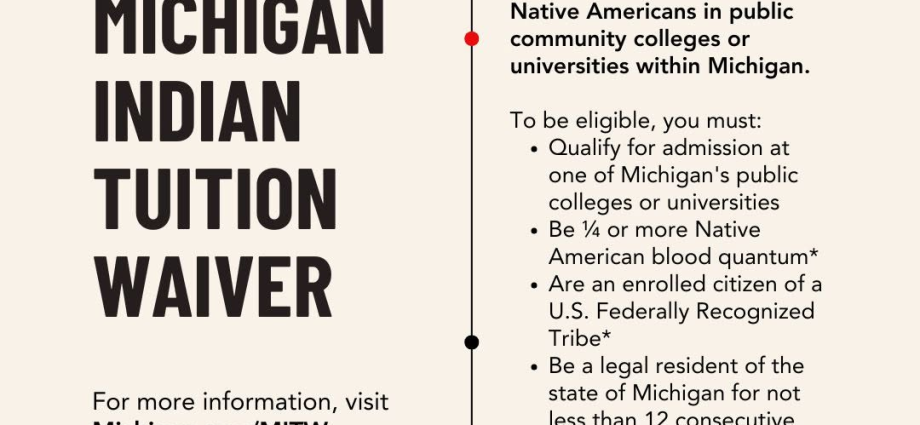
To be eligible, an applicant must meet all four of the following:
- Be an enrolled citizen of a tribe recognized by the United States federal government — this is not limited to Michigan’s own tribes; citizens of any federally recognized tribe nationwide qualify, provided they meet Michigan’s residency rule.
- Be certified by their Tribal Enrollment Department as at least one-quarter (25%) Native American blood quantum.
- Have lived in Michigan for at least 12 consecutive months immediately before applying.
- Qualify for admission at an eligible Michigan public institution.
Notably, the statute doesn’t add extra conditions around full- or part-time status, choice of major, or GPA — MiLEAP’s verification process doesn’t weigh any of that.
Michigan’s 12 Federally Recognized Tribes
A common point of confusion is assuming the waiver only applies to members of tribes headquartered in Michigan. It doesn’t — but since most applicants are connected to one of these, it helps to know them:
- Bay Mills Indian Community — Ojibwe nation based in Brimley, in the eastern Upper Peninsula.
- Grand Traverse Band of Ottawa and Chippewa Indians — headquartered near Peshawbestown, outside Traverse City.
- Hannahville Indian Community — a Potawatomi tribe based in Wilson, in the Upper Peninsula.
- Keweenaw Bay Indian Community — Lake Superior Chippewa nation in the Baraga/L’Anse area.
- Lac Vieux Desert Band of Lake Superior Chippewa Indians — based in Watersmeet, in the western Upper Peninsula.
- Little River Band of Ottawa Indians — headquartered in Manistee.
- Little Traverse Bay Bands of Odawa Indians — based around Petoskey and Harbor Springs.
- Match-E-Be-Nash-She-Wish Band of Potawatomi Indians (Gun Lake Tribe) — located near Shelbyville/Allegan County.
- Nottawaseppi Huron Band of Potawatomi — headquartered near Fulton, in Calhoun County.
- Pokagon Band of Potawatomi Indians — based in Dowagiac, in southwest Michigan.
- Saginaw Chippewa Indian Tribe — headquartered in Mount Pleasant.
- Sault Ste. Marie Tribe of Chippewa Indians — based in Sault Ste. Marie.
Documents You’ll Need
A complete MITW packet typically includes the official MITW application form (covering both a student section and a tribal certification section), a front-and-back photocopy of the applicant’s tribal enrollment or citizenship card, and proof of Michigan residency such as a state driver’s license or ID. The Tribal Enrollment Department fills out and signs the certification section confirming blood quantum and tribal citizenship; some tribes charge a small administrative fee for this certification (the Sault Tribe, for example, charges $15), so it’s worth checking with your specific tribe ahead of time.
Where You Can Use the Waiver
The MITW is valid only at Michigan public institutions — it cannot be used at private colleges or out-of-state schools. That still covers a wide range of options: all 15 of Michigan’s public universities, all 28 public community colleges, and the state’s two tribal colleges acting as pass-through institutions.
The 15 public universities are: Central Michigan University, Eastern Michigan University, Ferris State University, Grand Valley State University, Lake Superior State University, Michigan State University, Michigan Technological University, Northern Michigan University, Oakland University, Saginaw Valley State University, University of Michigan–Ann Arbor, University of Michigan–Dearborn, University of Michigan–Flint, Wayne State University, and Western Michigan University.
Michigan’s two tribal colleges, Bay Mills Community College and Keweenaw Bay Ojibwa Community College, also accept the waiver, as do the state’s community colleges. A student can even use the MITW at two eligible institutions simultaneously if dually enrolled.
How to Apply, Step by Step
- Get the application. Download the current MITW application from MiLEAP’s student aid site, or pick one up through your college’s financial aid office.
- Complete the student section. Fill out your personal and enrollment information, and attach a photocopy (front and back) of your tribal enrollment card.
- Send it to your Tribal Enrollment Department. This office certifies your blood quantum and tribal citizenship by completing and signing its section of the form.
- Confirm it reaches MiLEAP. Many tribes forward the certified application directly to MiLEAP; others return it to the student to submit. Either way, it’s the applicant’s responsibility to confirm the complete packet — student section, tribal certification, and supporting documents — actually arrives at MiLEAP.
- Wait for verification. Processing generally takes two to four weeks. If approved, MiLEAP sends a verification letter to both the student and the institution; if denied, the student receives a denial letter explaining why.
- Returning students skip most of this. Once verified, you don’t need to reapply every year at the same institution — just mark the “Continuing Student” box on a quick follow-up form if your school requests one. Transferring to a different eligible institution does require submitting an updated application referencing your prior verification.
Stacking the MITW With Other Financial Aid
The MITW only zeroes out tuition, so most students still need to cover fees, housing, and books — which is exactly what the FAFSA is for. Filing it opens the door to Pell Grants, Michigan state aid programs, and institutional scholarships that work alongside the waiver rather than against it. Some schools are also building targeted programs on top of the state waiver: Michigan State University, for instance, launched its own Native American Tuition Advantage Program (NATAP) starting fall 2025, extending in-state tuition rates to out-of-state Native American students who wouldn’t otherwise qualify for the MITW’s Michigan-residency requirement. It’s a separate, MSU-specific program, but worth knowing about if Michigan residency is the one box you can’t check.
Mistakes That Slow Down or Sink an Application
- Applying after the term already started. The waiver isn’t retroactive, so a late application can mean paying full tuition for that semester regardless of eligibility.
- Submitting only the student section. Without the tribal certification, MiLEAP has nothing to verify blood quantum or citizenship against, and the application stalls.
- Assuming the waiver auto-covers a new school after transferring. It doesn’t — transferring requires a fresh application referencing your prior MiLEAP verification.
- Treating it as a full-ride. Fees, housing, and books still need to be budgeted for separately.
- Skipping the FAFSA. Doing so leaves other available aid for non-tuition costs on the table.
Why the Program Still Matters
For eligible families, the MITW removes the single largest line item in a Michigan public college bill. It’s also one of the more durable tools the state has for closing a stubborn gap: Native American students nationally have seen some of the steepest declines in college enrollment of any demographic group in recent years. A program that erases tuition as a barrier — provided lawmakers keep funding it at the level the law requires — is a meaningful counterweight to that trend.
Frequently Asked Questions
Can I use the MITW at a private college? No. It’s valid only at Michigan’s public universities, public community colleges, and the state’s two tribal colleges.
Do I have to file the FAFSA to get the waiver? No, the FAFSA isn’t required for MITW eligibility itself, but filing it is strongly recommended since it unlocks additional aid for costs the waiver doesn’t cover.
Can graduate students use the MITW? Yes. The waiver applies to undergraduate and graduate coursework alike, including post-graduate work, at participating institutions.
What if I’m only enrolled part-time? That’s fine — the statute doesn’t limit eligibility based on full-time or part-time status.
Can I use it for summer classes? Yes, the waiver applies to any term, including summer.
What happens if I transfer schools? You’ll need to submit a new application marking the “continuing student” box and referencing your existing MiLEAP verification, rather than starting from scratch.
Do I need to reapply every year? Not if you stay continuously enrolled at the same institution. Some schools may ask you to complete a brief renewal form, but it’s not the full application process again.
Can I be dually enrolled at two schools and use the MITW at both? Yes, as long as both institutions are eligible Michigan public colleges or universities.
Will MiLEAP reimburse me for a semester I already paid for? No. The waiver isn’t retroactive, so prior semesters aren’t eligible for reimbursement.
Is there a fee to get my blood quantum certified? It depends on your tribe. Some charge a modest administrative fee for the certification process — check directly with your Tribal Enrollment Department.
How long does MiLEAP take to process an application? Typically two to four weeks once a complete, tribally certified application is received.
Does my tribe have to be based in Michigan? No. Citizenship in any federally recognized U.S. tribe qualifies, as long as you also meet Michigan’s 12-month residency requirement.
Where to Go for Help
- MiLEAP’s MITW program page: michigan.gov/mitw
- MITW program contact: 888-447-2687 or mitw@michigan.gov
- Your Tribal Enrollment Department (for certification questions and fees)
- Your college’s financial aid office (for school-specific forms or deadlines)
- FAFSA, at studentaid.gov (for aid covering costs beyond tuition)
Final Thoughts
The Michigan Indian Tuition Waiver traces back to an 1817 treaty promise that took more than 150 years and a federal lawsuit to turn into state law — and it’s still one of the most underused benefits available to eligible students in Michigan. If you meet the four core requirements, the smartest move is to start the tribal certification process early, since that step is usually what takes the longest, and to pair the waiver with a completed FAFSA so nothing outside of tuition gets left unfunded.
Image source: MiLEAP