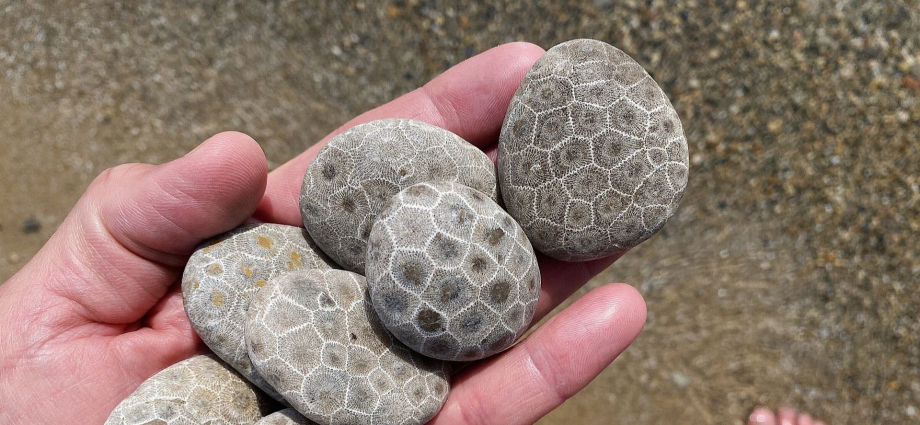
Petoskey Stone Only in Michigan: A Fossil Found Nowhere Else on Earth
The Petoskey stone only in Michigan can be found, and that singular fact makes this humble fossil one of the most exciting things you can discover along the Great Lakes shoreline. I remember the first time I picked one up on a cold April morning along the shores of Lake Michigan — wet, gray, and utterly unremarkable-looking until I turned it over and saw those perfect honeycomb hexagons staring back at me like tiny eyes from 350 million years ago.
That moment hooked me completely. These fossilized coral colonies, once alive in a warm tropical sea that covered what is now Michigan, have been eroding out of glacial deposits for thousands of years and washing onto beaches that belong entirely to this state. Whether you are a seasoned rockhound or a first-time beachcomber, finding a Petoskey stone feels like holding a secret that only Michigan keeps.

What Exactly Is a Petoskey Stone?
If you have never heard of a Petoskey stone before, you are not alone — plenty of people walk right over them on the beach without a second glance. A Petoskey stone is the fossilized skeletal remains of a colonial coral called Hexagonaria percarinata, a creature that once lived in enormous reef systems across what is now the American Midwest. The name comes from the city of Petoskey in northern Michigan, though the stones wash up along hundreds of miles of shoreline well beyond that single town.
What makes them instantly recognizable is their pattern: a series of six-sided (hexagonal) cells, each one the preserved chamber of an individual coral polyp. When the stone is dry, it looks like an ordinary gray rock. When it is wet — or polished — those chambers light up in gorgeous detail, showing a central dark eye surrounded by radiating lines, like a tiny sunflower or a miniature stained-glass window repeated across the whole surface. There is nothing else quite like them anywhere on the planet, which is a big part of why Petoskey stone facts circulate so enthusiastically among Michigan travelers and rock collectors alike.
The Geology: Fossilized Coral from 350 Million Years Ago
A Tropical Sea in the Middle of North America
To understand why the Petoskey stone only in Michigan exists, you have to rewind about 350 million years to the Devonian Period. At that time, what is now the Lower Peninsula of Michigan sat very close to the equator, covered by a warm, shallow sea teeming with marine life. Vast coral reefs stretched across this inland ocean, and Hexagonaria was one of its dominant builders, forming colonies that could spread across acres of warm, sunlit seafloor.
Over millions of years, sediment buried these reefs, pressure compressed them into limestone and dolostone, and tectonic forces slowly shifted the land northward. Then, during the last ice age, massive glaciers scraped across Michigan repeatedly, grinding up the bedrock, picking up those fossilized coral chunks, and redistributing them across a wide swath of the northern Lower Peninsula and parts of the Upper Peninsula. When the glaciers retreated, they left behind gravel beds laced with Petoskey stones, which rivers and waves have been sorting and exposing onto beaches ever since.
Why Only Michigan?
The concentration of Hexagonaria-bearing bedrock happens to sit squarely beneath northern Michigan, and the glacial processes that ground it up and deposited it were uniquely focused here. Isolated examples of related coral have turned up in a few other places worldwide, but the density, the accessibility, and the legal ability to collect them freely on public beaches is a Michigan-only phenomenon. For a deeper dive into Michigan geology and travel, Pure Michigan maintains excellent resources on the natural history behind the state’s most iconic landmarks.
Where Are Petoskey Stones Found in Michigan?
The short answer is: all along the northwestern Lake Michigan shoreline and parts of Lake Huron. But some beaches give you dramatically better odds than others. I have spent entire mornings combing the gravel at the best places to find Petoskey stones in the state, and the difference between a productive beach and a fruitless one is real.
| Location | Best Season | Beach Type | Difficulty |
|---|---|---|---|
| Petoskey State Park | Spring & Fall | Gravel and sand mix | Easy |
| Traverse City area beaches | Spring after storms | Sandy with gravel pockets | Moderate |
| Sleeping Bear Dunes shoreline | Late spring | Mixed gravel | Moderate |
| Leelanau Peninsula | Spring & Fall | Rocky gravel | Easy to Moderate |
| Rogers City (Lake Huron) | Spring | Limestone gravel | Easy |
| Cheboygan area | Year-round | Mixed shoreline | Moderate |
The region around Traverse City is a particularly wonderful base for a stone-hunting trip because you get excellent beaches within easy driving distance alongside world-class dining, Michigan wine trail tasting rooms, and spectacular sunsets over Grand Traverse Bay. If you are planning a broader northern Michigan adventure, a ferry day trip to Mackinac Island pairs beautifully with a morning of beach hunting on your way north.
Best Beachcombing Tips for Finding One
Timing and Conditions
Spring is the undisputed prime season for Petoskey stone hunting. Winter storms churn up Lake Michigan’s shallow gravel beds and deposit fresh stones on the beach, and by April and May the shoreline is littered with new arrivals that have not yet been picked over. Fall storms after Labor Day produce a second wave of excellent finds after summer crowds thin out. Midweek visits — especially after a stormy night — give you the best shot at unsearched ground.
Pro Tip: Always search wet gravel, not dry sand. A dry Petoskey stone looks like every other gray pebble on the beach. Splash a little lake water on any candidate stone or carry a small spray bottle. That quick wetting reveals the hexagonal pattern instantly, saving you from carrying home a bag of ordinary limestone.
What to Look For and What to Bring
Train your eye to look for rounded gray stones with a slightly bumpy or textured surface. The pattern is subtle when dry, so do not expect it to leap out at you. Crouch low, move slowly, and work gravel bars rather than sandy stretches. Gravel bars — especially those at creek mouths and near points of land — concentrate the heaviest stones naturally.
Pack a small mesh bag or bucket, a spray bottle filled with water, knee pads if your back protests long crouching sessions, and sun protection — the glare off the water is intense even on cloudy days. Comfortable waterproof shoes let you wade into the shallows where unpolished stones sit just offshore, often in better condition than beach-worn specimens. The Lake Michigan beaches around Petoskey and Charlevoix are particularly well suited to this kind of wading search.
Insider Secret: The absolute best time to search is within two hours after a major storm passes through. High waves stir up fresh material, and you will often find stones that still have sharp, unworn edges — a sign they were recently freed from the gravel bed rather than tumbled for years. I once found a fist-sized specimen with perfect, crisp hexagons the morning after a November gale. It now sits on my desk.
Staying Legal and Ethical
On most public beaches and state parks in Michigan, casual collection of small quantities of Petoskey stones for personal use is perfectly legal. However, collecting is prohibited inside certain protected areas, so always check the rules for the specific park or shoreline you are visiting. Taking a few stones for personal use is the spirit of the law; commercial-scale harvesting is not.
Michigan State Stone: History and Official Status
The Michigan state stone designation was officially granted to the Petoskey stone in 1965, making Michigan one of the first states to formalize a state stone. The choice reflected both geological pride and cultural identity — by the mid-twentieth century, Petoskey stones had already been embedded in northern Michigan tourism for generations, sold in gift shops, carved into jewelry, and given as souvenirs. The state stone status simply codified what locals already knew: this fossil is Michigan’s most distinctive natural ambassador.
Interestingly, Hexagonaria percarinata is also the official state fossil of Michigan, creating the somewhat unusual situation where the same organism holds two official designations. The distinction is minor but telling — Petoskey stone facts like these are the kind of trivia that make Michigan nerds very happy at dinner parties.
How to Clean, Polish, and Display Your Find
Basic Cleaning
Fresh-from-the-beach stones sometimes have algae, sand, or clay in their surface crevices. A stiff toothbrush and warm soapy water handles most of it. Let the stone dry completely before moving to any polishing step.
Hand Polishing
You can achieve a beautiful polish entirely by hand using progressively finer grits of wet-dry sandpaper — start around 220 grit, work through 400, 600, and finish with 1000 or higher. Keep the stone wet throughout. The transformation as those hexagonal cells emerge under 600-grit paper feels almost miraculous. Finish with a light coat of mineral oil to deepen the color and protect the surface. The result is a stone that looks like it was tumbled professionally, smooth and dark, with those ancient coral chambers glowing in rich contrast.
If you catch the stone-hunting bug on a broader Michigan road trip, you will find rock-tumbling supplies at most outfitter shops and tourist stores throughout the Petoskey and Sleeping Bear Dunes region. Several local jewelers also offer custom settings to turn your find into a pendant or ring, which makes for a deeply personal souvenir.
Frequently Asked Questions
Why is the Petoskey stone only in Michigan?
The fossilized coral species Hexagonaria percarinata is concentrated in the limestone bedrock beneath northern Michigan, deposited there 350 million years ago when the region was covered by a warm tropical sea. Repeated glaciation ground up that bedrock and distributed the fossils along Lake Michigan and Lake Huron shorelines, making Michigan the only place on Earth where they appear in such abundance on accessible public beaches.
What are some essential Petoskey stone facts for first-timers?
Petoskey stones are fossils, not rocks — they are the skeletal remains of colonial coral polyps. Each hexagonal cell represents one individual polyp. They are roughly 350 million years old. They are designated both the Michigan state stone and the Michigan state fossil. They look like plain gray gravel when dry but reveal their distinctive honeycomb pattern when wet or polished. Spring and fall after storms are the best times to find them.
Where are Petoskey stones found most reliably?
The highest concentrations appear along gravel beaches on the northwestern Lower Peninsula shoreline, especially near Petoskey State Park, the Leelanau Peninsula, Charlevoix, and the northern shores of Grand Traverse Bay near Traverse City. Lake Huron beaches near Rogers City also produce good finds. Gravel bars, creek mouths, and storm-deposited wrack lines are your best bets on any beach.
Can I take Petoskey stones home from Michigan beaches?
Yes, in most cases. Personal-use collecting of small quantities is permitted on most public beaches and state parks in Michigan. There are exceptions in certain protected natural areas, so always verify the rules for the specific location you are visiting before collecting. Commercial harvesting is not permitted.
When is the best time to search for Petoskey stones?
Early spring — April and May — is widely considered the best season because winter storms expose fresh material. The two to three days immediately following a major storm are ideal at any time of year. Mornings on weekdays, before other beachcombers arrive, also significantly improve your odds of finding undisturbed stretches of gravel.
Do I need special equipment to find Petoskey stones?
No special equipment is required, but a small spray bottle of water, a mesh collecting bag, and waterproof shoes make the experience much more productive and comfortable. The spray bottle is particularly helpful because it lets you quickly wet potential stones to check their pattern without having to wade or wait for a wave.
The Petoskey stone only in Michigan story is one of the best arguments I know for slowing down and really paying attention to the ground beneath your feet when you travel here. From the ancient coral reefs of the Devonian sea to the cold gravel of a May morning on Lake Michigan, these fossils carry an astonishing amount of time in a package small enough to fit in your pocket. If you are building out a northern Michigan itinerary, combine your stone hunting with a hike through Sleeping Bear Dunes, a night of stargazing from a lakeside campsite, or a weekend exploring the Michigan lighthouses that dot this same dramatic shoreline. If traveling with children, beachcombing for Petoskey stones ranks among the most memorable things to do in Michigan with kids — there is something about handing a child a 350-million-year-old fossil they found themselves that no museum exhibit can replicate. Michigan is full of places and experiences that exist nowhere else on Earth, and the Petoskey stone is simply the most tangible proof you can hold in your hand.